Every industry operates within its own logic, shaped by processes, regulations, and language.
Standard CRM platforms have helped many organisations build strong digital foundations. As complexity grows, the question shifts from features to structural alignment with industry reality.
➡️ Insurance companies don’t just manage leads; they manage policy lifecycles, underwriting risk, and claims portfolios.
➡️ Banks don’t just manage accounts; they manage relationship lifecycles, from onboarding and KYC to lending, advisory, servicing, and long-term portfolio management.
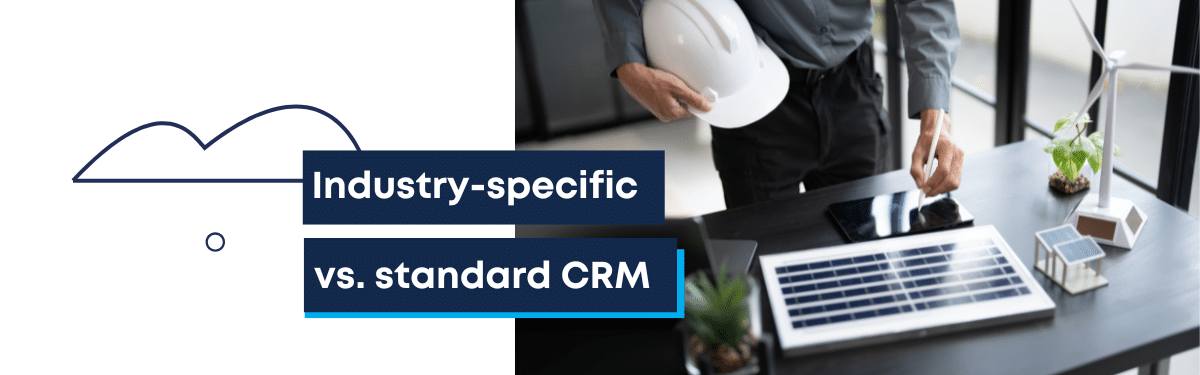
➡️ Manufacturers don’t just manage opportunities; they manage distribution ecosystems, production lifecycles, installed base assets, and service operations.
According to Gartner (2025), more than 50% of organisations are expected to use industry cloud platforms by 2029 to accelerate business initiatives and reduce technical debt.*
Let’s break down three common myths and see when industry-specific capabilities become a structural advantage.
3 myths keeping companies stuck in generic CRM thinking
Myth 1: “We Are Very Unique”
Every company is unique. To a point.
Beyond that, many core processes are shaped by regulation, market structure, and operating models.
When organisations position themselves as unique, they often over-tailor the system, increasing their reliance on ongoing development and maintenance.
Salesforce architecture is configuration-driven rather than development-heavy. That allows depth without long-term technical burden. But configuration alone does not create an advantage.
Real value comes from aligning industry architecture with your operating model, focusing on customisation where it differentiates you while leveraging proven structures elsewhere. That balance requires a partner who understands both the platform and the industry logic behind it.
Myth 2: “Standard CRM is cheaper; we’ll add industry specifics later.”
Standard CRM often appears more affordable at first. The logic seems simple: begin with a generic foundation and add industry specifics over time.
In practice, adding industry complexity to a system built on a different foundation requires process adjustments, extended data structures, and additional workflows.
What looked like a lower upfront investment can become a higher implementation and maintenance effort, slower adaptation to market and regulatory change, and no delivery of embedded industry best practices.
The real question is not which option looks cheaper initially, but which architecture reduces structural complexity and supports faster, measurable ROI over time.
An experienced industry-focused partner helps define the right foundation from the start, avoiding structural rework later and accelerating time-to-value.
Myth 3: “Industry clouds lock you in”
The question of control is a valid one in any long-term platform decision.
But the real question is: do you need unlimited customisation, or the ability to evolve efficiently on a foundation of embedded industry best practices?
When industry logic isn’t built into the foundation, flexibility often turns into continuous tailoring, increasing complexity and slowing change.
Industry-aligned architecture doesn’t lock you in. It standardises what the industry has already standardised while preserving adaptability where real differentiation matters.
The real challenge is not control, it’s ensuring your system can adapt quickly without increasing structural complexity.
An experienced industry-focused partner helps you strike that balance, protecting flexibility where it drives value, while avoiding unnecessary architectural drift.
Book a free consultation and see how we can help you reach your goals.

The new standard: platform power + industry depth
In practice, we consistently see:
➡️ ERP- or core-system-led architectures are not front-office-native. Customer processes become slower and fragmented.
➡️ 3rd-party-built add-on industry layers rarely mean deeply embedded industry models. This leads to heavier customisation and harder change management.
➡️ Department-specific solutions cannot create enterprise alignment. This creates silos and limits end-to-end visibility.
Performance does not scale without the right foundation. Salesforce combines platform scale with industry depth, enabling faster alignment and lower structural complexity through:
- enterprise-grade, scalable platform architecture
- embedded industry-specific data models and workflows (financial services, manufacturing, public sector, health, retail…)
- connected front-office architecture: sales, service, marketing, and data, with AI embedded in everyday workflows
This combination enables alignment while reducing structural complexity. Regulatory updates, process changes, and innovation cycles become faster and less disruptive.
The real decision is structural
Standard CRM is not wrong. It has helped many organisations build solid foundations. But in complex, regulated, or growing environments, a generic approach often requires additional structuring to reflect industry realities.
The real question is simple:
Do you want to build your industry logic inside a system?
Or start from a system already built for your industry, with best practices embedded into its core logic?
Agilcon brings deep industry expertise and hands-on experience. We understand the operational pressures, compliance constraints, and executive trade-offs that shape system decisions.
If you are evaluating whether deeper industry alignment makes sense for your organisation, we can support you with a focused strategic roadmap:
- Identify where structural complexity slows execution
- Define measurable ROI and time-to-value targets
- Design a phased, low-risk transition plan
Stronger performance does not come from more customisation. It comes from architecture that reflects how your industry actually operates, backed by the right expertise.
*Source: *Gartner Identifies the Top Trends Shaping the Future of Cloud, 2025
Contact us
"*" indicates required fields